TWO MAJOR SOLO EXHIBITIONS BY BETTY MUFFLER AND MEHWISH IQBAL EXPLORE HEALING, CARE AND INTERCONNECTEDNESS
Bundanon has announced its Summer 2026–27 exhibition season which brings together two major presentations by senior Aṉangu artist and ngangkaṟi (traditional healer) Betty Muffler and Pakistani-born Australian artist Mehwish Iqbal, whose practices are grounded in cultural knowledge, collaboration, and connection to place.
Presented in the Art Museum from 31 October 2026 – 14 February 2027, this season marks Betty Muffler’s first major institutional solo exhibition, presented alongside an ambitious, multidisciplinary exhibition showcasing newly commissioned textile works by Mehwish Iqbal. Developed through longstanding relationships with community and artisan collaborators, these exhibitions reveal enduring ties between culture, identity, Country and community. Together, they offer a compelling reflection on the stories and traditions that continue to shape Australia today.
Rachel Kent, CEO, Bundanon said: “Bundanon is delighted to announce our Summer 2026-27 exhibition season, featuring two landmark solo exhibitions by leading artists Betty Muffler and Mehwish Iqbal. Working across vastly different mediums and traditions, Muffler and Iqbal each consider how art can foster restoration, resilience and collective understanding. Grounded in Betty Muffler’s Aṉangu knowledge and traditional healing practices, and in Mehwish Iqbal’s exploration of migration, textile traditions and cross-cultural collaboration, they invite audiences to reflect on the ways that care and community can shape personal and collective transformation. I have followed both artists’ work for many years, and we are deeply honoured to present their remarkable exhibitions at Bundanon. At a time of significant global upheaval, this season offers a quiet space for healing through storytelling, prioritising connection and our shared humanity.”
Betty Muffler was born in 1944 at Yalungu in the remote north-west of South Australia and is based at Indulkana in the Aṉangu Pitjantjatjara Yankunytjatjara (APY) Lands of South Australia. She grew up at various locations on the APY Lands, including the Ernabella Mission in Pukatja following the displacement her family members in the wake of British atomic testing at Maralinga and Emu Plains. This enduring legacy informs her cultural and creative practice, with her paintings and works on paper depicting sacred sites associated with Tjukurpa (Ancestral creation stories) and ngangkaṟi (healing), under the shared title Ngangkaṟi Ngura (Healing Country). Passed down to her through her father’s family and paternal aunties, Muffler’s healing powers have supported community health and resilience over decades, and she has worked extensively as a senior member of the Ngaanyatjarra Pitjantjatjara Yankunytjatjara (NPY) Women’s Council ‘Ngangkari Program’.
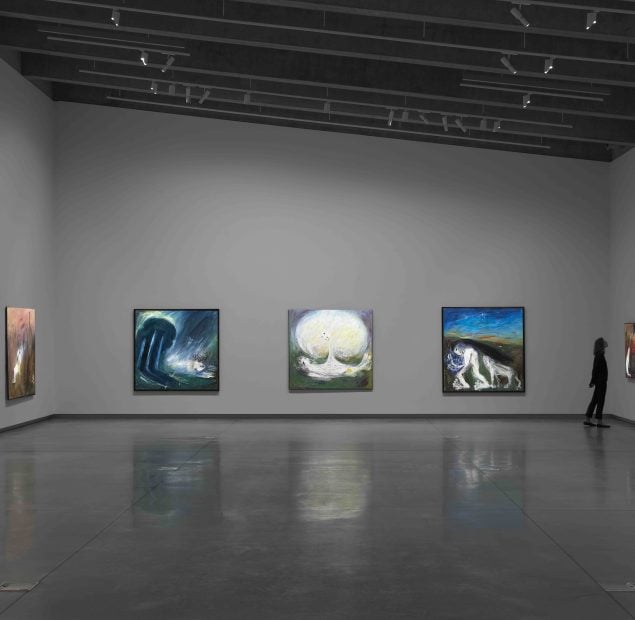
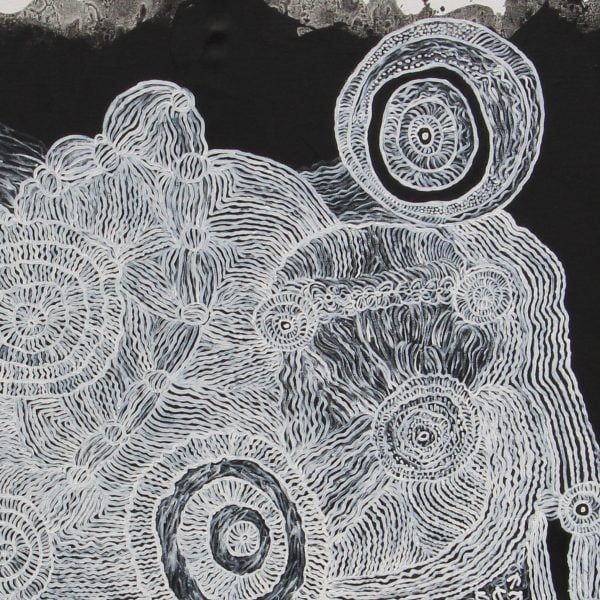
Bringing together a suite of new paintings created especially for Bundanon alongside major loans, Ngangkaṟi Ngura – Healing Country traces Muffler’s recent practice with a focus on the powerful monochromatic works for which she has become widely recognised, from 2020 to the present. Working with acrylic paint and oil stick on linen, her paintings are informed by Country, healing and lived experience. Wavy lines of water connect to radiating, circular waterholes and emu tracks in the works, conveying the detail and immensity of her Country with its striking rock hills and wandering emus. Through her art, Muffler preserves memory, honours ancestral knowledge and asserts her enduring connection to the land.
“Through my paintings you can see my Ngangkaṟi work: watching over people and also looking after Country. My Country. This place is very important—we all need to look after each other and respect our home.” — Betty Muffler
The exhibition includes significant loans from public and private collections across Australia, including the Art Gallery of NSW, National Gallery of Australia, National Gallery of South Australia and Ian Potter Museum of Art, alongside works from Iwantja Arts Centre. Exhibition highlights include large-scale collaborative works by Muffler and family member Maringka Burton, a respected senior artist and ngangkaṟi like Muffler; as well as a major community work, Ngura Nganampa Wintjiri Wiru Ngaranyi – Our Beautiful Country (2025), by senior Aṉangu women Maringka Burton, Betty Chimney, Kunmanara (Nellie Ngampa) Coulthard, Emily Cullinan and Betty Muffler. Muffler and Burton’s distinctive collaborations – some measuring over five metres in scale – are characterised by their soft lilac and cream hues, a counterpoint to the black and white palette for which Muffler is well known.
The exhibition will be accompanied by a new documentary film produced by Iwantja Arts in collaboration with Bundanon, offering insight into the cultural knowledge and healing practices that continue to shape Muffler’s creative practice.
One of Australia’s most compelling contemporary artists, Mehwish Iqbal explores migration, memory, ecology and cultural exchange through her creative practice. Iqbal’s Bundanon exhibition Bait-al-Nahl – The House of Bees positions the hive as its central motif. A structure of shared habitation, production and nurture, it recalls the human world and communities which ebb and flow around the globe through migration and displacement. Bait-al-Nahl refers to Qur’anic verse and the role of the bee which builds its home in the mountains, trees and human structures, producing nectar to provide healing for humankind.
Working across paper, silk and sculptural installation, Iqbal creates intricate works that draw upon age-old traditions including siah qalam (an ancient Persian tradition of monochromatic drawing) and community-led artisanal collaboration. At the centre of her exhibition, she presents five new, handwoven silk works, developed with artisan communities in India, Thailand and Pakistan. Drawing on histories of movement and connection across borders, they reflect women’s communal practice, knowledge and traditions passed down through generations.
“My practice is grounded in the idea of harmony—how it is made, fractured, and reimagined in times of uncertainty. This body of work comes at a moment of global unrest, shaped by displacement, migration, and the loss of home. In response, I create works that invite reflection, introspection, and hope.” — Mehwish Iqbal
Exhibition highlights include Iqbal’s monumental 12-metre silk work, hand-woven by artisans in Murshidabad, India before being printed and embroidered by the artist and her daughter in western Sydney. Drawing on traditions of Persian miniature painting, while responding to Australia’s flora and fauna, the work considers silk as both material and metaphor, carrying histories, knowledge and cultural exchange across boundaries. A reclining, pregnant body becomes the terrain about which real and mythological creatures converge, and a motif of enduring feminine power.
A further textile commission comprises four panels of hand-woven silk produced by the last traditional Muslim silk-weaving family in southern Thailand. Woven in graduated shades of red – from bright red to dark, clotted blood tones – and embroidered with iconography of human and animal forms, the work continues Iqbal’s exploration of movement, circulation and interconnectedness across human and ecological systems. Each panel comprises two halves, held together by a delicate row of vertical red threads; and their elaborate imagery has been embroidered by women artisans working alongside the artist in Lahore, Pakistan.
The exhibition also features Magamarch, a six-metre monochromatic work on paper employing siah qalam technique, alongside sculptural installations examining identity, trade, ritual and remembrance. Highlights include Poppy Crop, a vast field of hand-cast ceramic poppies; Chinar, a series of porcelain sycamore seed pods reflecting on contested identities and place; and Last Prayer, a contemplative installation of individually carved porcelain date seeds exploring mourning, remembrance and the rituals of Ramadan.
“We migrate. We leave and return. We carry languages, memories, rituals, griefs, and fragments of belonging across borders and generations. Our paths are rarely linear. In movement, we encounter other worlds, and from these encounters emerge new cultures, traditions, solidarities, and ways of imagining home. Healing, too, may reside in this movement, in the patience to listen, the sensitivity to inhabit another’s world, the compassion to recognise our interdependence with one another and with the earth.” — Mehwish Iqbal
ENDS
IMAGES AVAILABLE HERE
MEDIA CONTACTS
To request interviews, further information or imagery please contact Articulate:
Siân Davies sian@articulateadvisory.com 0402 728 462 or
Sasha Haughan sasha@articulateadvisory.com, 0405 006 035
ABOUT BUNDANON
Bundanon acknowledges the people of the Dharawal and Dhurga language groups as the traditional owners of the land within our boundaries, and recognises their continuous connection to culture, community and Country.
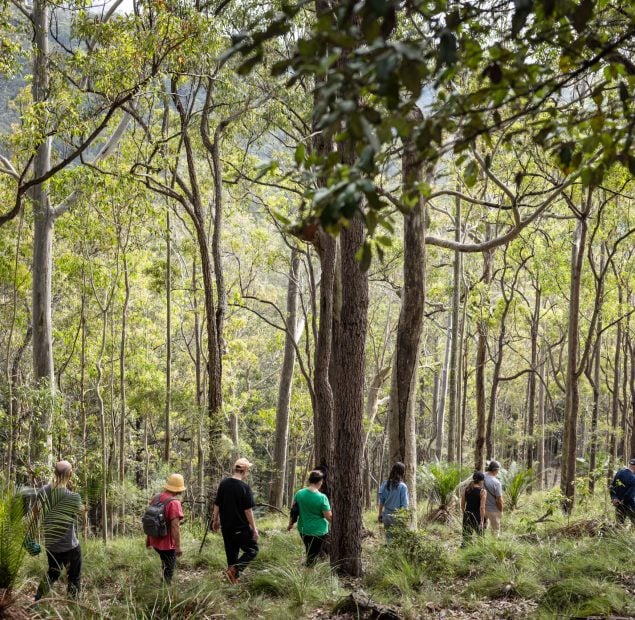
Established in 1993, Bundanon was gifted to the Australian people by Arthur and Yvonne Boyd, representing one of the most significant acts of philanthropy in the history of the arts in Australia. Bundanon is located on 1,000 hectares of bush and parkland overlooking the Shoalhaven River, on the South Coast of New South Wales, two and a half hours from Sydney.
Bundanon’s mission is to operate the property as a centre for the creative arts and education, for scientific research and a place to explore landscape and engage with First Nations history and culture.
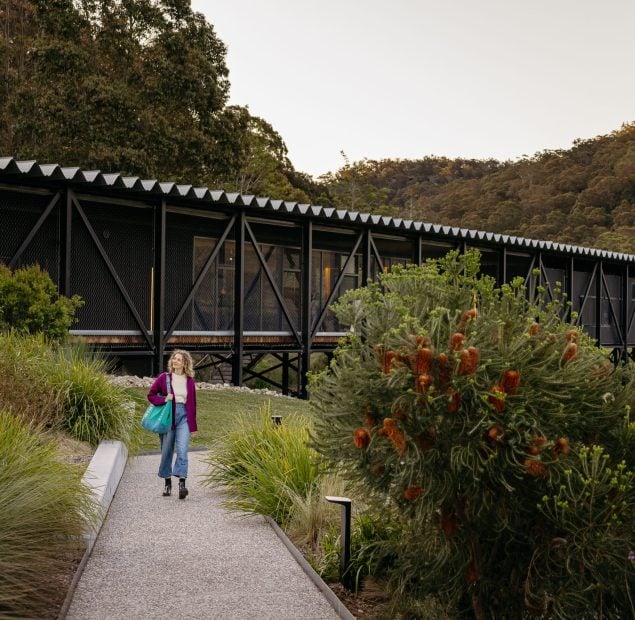
In 2022, Bundanon opened its purpose-built Art Museum, Bridge for Creative Learning and wider infrastructure to the public, designed by Kerstin Thompson Architects (KTA).
The Art Museum presents three major exhibition seasons each year, encompassing a diverse array of contemporary practices across a range of disciplines, contextualised by the significant historical legacy of Bundanon’s Art Collection. The exhibitions are presented alongside expansive live programs, accommodation and dining experiences.
Bundanon’s live programs reflect its engagement across artforms, encompassing artist talks and workshops, performances, dance, concerts and festival events. Highlights include the Boyd Music Series in partnership with Sydney Opera House, celebrating Australian and international chamber music against the unique backdrop of the Bundanon landscape.
Bundanon’s residency program and its learning programs, are an investment in Australia’s future. The Learning program is inclusive and designed for all ages, and welcomes over 5,000 school students for day or overnight visits each year.
Bundanon’s Artists in Residence program is the largest program of its kind in Australia and spans a 30-year history. Every year, more than 300 artists and researchers from across artistic disciplines are in residence, embracing the visual and performing arts, literature, science, dance, music and environmental research. This provides important career opportunities for artists and researchers to develop their work in an inspiring environment.
Bundanon is supported by the Australian Government through the Department of Infrastructure, Transport, Regional Development Communications, Sport and the Arts.
For more information visit bundanon.com.au
ABOUT BETTY MUFFLER
Betty Muffler is an artist and highly respected senior woman and renowned ngangkaṟi (traditional healer) who lives and works at Iwantja Arts in Indulkana, on the Aṉangu Pitjantjatjara Yankunytjatjara (APY) Lands of South Australia.
Betty was born at Yalungu SA, a site associated with Kalaya Tjukurpa (emu ancestral creation story) and emus and their tracks are a recurring motif in her art. Betty grew up at various locations across the APY Lands, including the Ernabella Mission after her family members were impacted by the British nuclear testing at Maralinga and Emu Field.
Betty started working at Iwantja Arts in Indulkana later in life and has developed a distinctive multidisciplinary practice spanning painting, drawing, printmaking and tjanpi (native grass) weaving. Her artistic practice is deeply grounded in cultural knowledge, connection to Country and a lifelong commitment to healing and caring for community.
Betty’s work has received significant national and international recognition. In 2017, she won the Emerging Artist Award at the Telstra National Aboriginal and Torres Strait Islander Art Awards (NATSIAA). In 2020, her work was featured on the cover of Vogue Australia, and she was a feature artist in Tarnanthi at the Art Gallery of South Australia (AGSA).
In 2022, Betty was selected for The Macfarlane Commissions with the Australian Centre for Contemporary Art (ACCA), Melbourne, and was awarded the General Painting Prize at NATSIAA. In 2023, she presented new work in the NGV Triennial at the National Gallery of Victoria (NGV), Melbourne. In 2025, Betty presented new work for Encounters at Art Basel Hong Kong and was curated into Abu Dhabi Art in Abu Dhabi.
ABOUT MEHWISH IQBAL
Mehwish Iqbal is a multidisciplinary artist working across painting, printmaking, textiles, ceramics, sculpture and installation. Her practice interrogates womanhood, power, migration, and the fragile states shaped by geopolitical conflict. Through communityengaged processes, she creates works that respond to the resilience and vulnerabilities of marginalized people across historical and contemporary contexts. Nature forms a vital thread in her work, where animal symbolism, flora and fauna, and archaic references illuminate the tensions between human agency and hierarchical systems.
Iqbal’s recent achievements include major international residencies such as the 2025 DPA Visual Arts Residency at SAC Gallery (Thailand) and the Cité Internationale des Arts residency supported by the Art Gallery of NSW. She was a 2025 Debra Porch Award and Dyason Scholarship recipient, and her work was aquired in the 2025 Wynne Prize at the Art Gallery of NSW. Her solo exhibition Shifting Ecologies (2025) at Cité des Arts in Paris further marks her growing global presence.