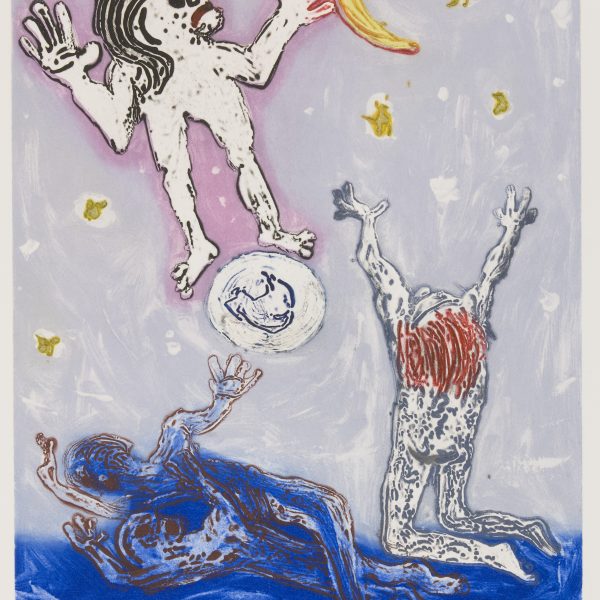
Listen to Indra Deigan’s reading of Sangkuriang, the West Javanese legend first documented in the 15th century.
‘Once the collagraph plates were completed I made woodcut images in response to, and to compliment the strong colour and fluent mark making of Arthur Boyd. As a further contrast I chose semi-transparent paper, allowing both images to harmoniously act as one when seen as an overlay or as a ghost image on the left page when viewing the collagraph.’ – Indra Deigan
Arthur Boyd is best known for his emotive paintings of the Australian bush, but he experimented with many mediums throughout his career, often collaborating with other artists. In 1989, Boyd met printmaker Tony Deigan, who introduced him to the emerging medium of collagraphy. The rich colours and textures created through the collagraph process lent themselves to Boyd’s expressive imagery and the pair worked together on several projects, both in England and Australia.
In the early 1990s, Indra Deigan invited Boyd to collaborate on an artist’s book she was developing for her graduate studies in Canberra. Boyd proposed that an Indonesian story be chosen as the subject matter, continuing his lifetime interest in mythology and reflecting Deigan’s heritage. The legend selected, Sangkuriang, is about a mountain near Deigan’s hometown of Bandung, West Java, called Tangkuban Perahu, which translates to ‘an upside-down boat’.
Boyd created ten original collagraphs depicting dramatic scenes from the story. Indra Deigan then responded with her subtle woodblock printing and text, building key moments in the narrative, and personally binding six of ten editions. Tony Deigan guided the technical aspects of the printmaking while John Tonkin bound four leather editions of the book.
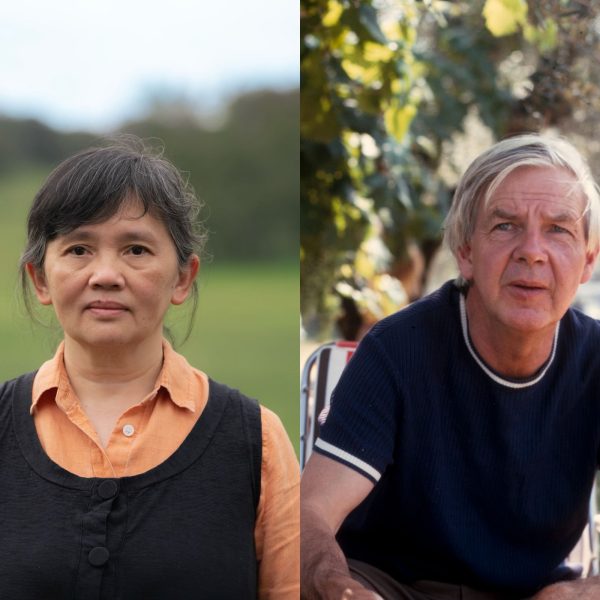
Indra Deigan
Indra Deigan (nee Surya Seputra) is an Indonesian born graphic artist of Chinese descent who collaborated with Arthur Boyd in the early 1990s. Growing up in West Java, Indra studied graphic design at the Institute of Technology, Bandung, and at Central Saint Martin’s College of Art and Design, London. There she pursued an interest in printmaking, especially artist’s books. Indra met Arthur Boyd at his home in Suffolk, when accompanying her then husband Tony Deigan, a master printmaker and technician who introduced Boyd to collagraph.
In 1993, after migrating to Australia and transferring to the Canberra Institute of the Arts at the Australian National University, she and Boyd collaborated on the printing of Sangkuriang – a legend from West Java, an editioned artist book featuring original collagraphs and woodcuts.
Arthur Boyd
Arthur Boyd (b. 1920, d. 1999) was one of the most celebrated Australian artists of the 20th century. He worked predominantly as a painter, potter and printmaker, but also collaborated with many artists in diverse media.
Boyd is known for his depictions of myth and religious narrative, often set within the Australian bush, as well as the humanitarian themes that he explored throughout his life. His early years were spent in Victoria, and he was conscripted to the army from 1941 to 1944. Throughout the 1960s, he worked in London, undertaking major design commissions with the ballet and opera, before returning to Australia in 1971. Boyd represented Australia at the Venice Biennale in 1977 and 2000 and exhibited nationally and internationally throughout his life. A major retrospective of his work was held at the Art Gallery of New South Wales in 1993, the same year that he and Yvonne Boyd gifted Bundanon to the Australian people.